
3 Pool Basics That Fix Almost Any Miss

When a new player sits down at my table for the very first time, I don’t ask them about their aiming, about their break, or even their best shot.
I get them to cue across two spots. And within about 30 seconds, I can see everything I need to see.
After 60 years of coaching - from complete beginners to players who’ve gone on to compete at world level - it always comes back to the same three things. Not five. Not ten. Three. And almost every player I meet is getting at least one of them wrong.
Fundamental #1: The butt of the cue against your chest
This is the one I repeat more than anything else. If I had to pick the single most important thing I teach, this is it.
The butt of your cue needs to be pressed firmly against your chest. Not near it. Not close to it. Against it. I wear a waistcoat when I play competitions, and I go through one every two years just from the cue rubbing on it. That’s how firm it needs to be.
When the butt is floating - and nearly every player I meet has a floating back hand - your tip wanders. It might only be a few millimetres off line, but over the length of the table, those millimetres become centimetres. And centimetres mean misses.
The moment you anchor the butt against your chest, the cue can only go one way: straight. And once you implement this one tip, you’ll find yourself cueing straighter in no time.
Fundamental #2: Grip the table with your front hand
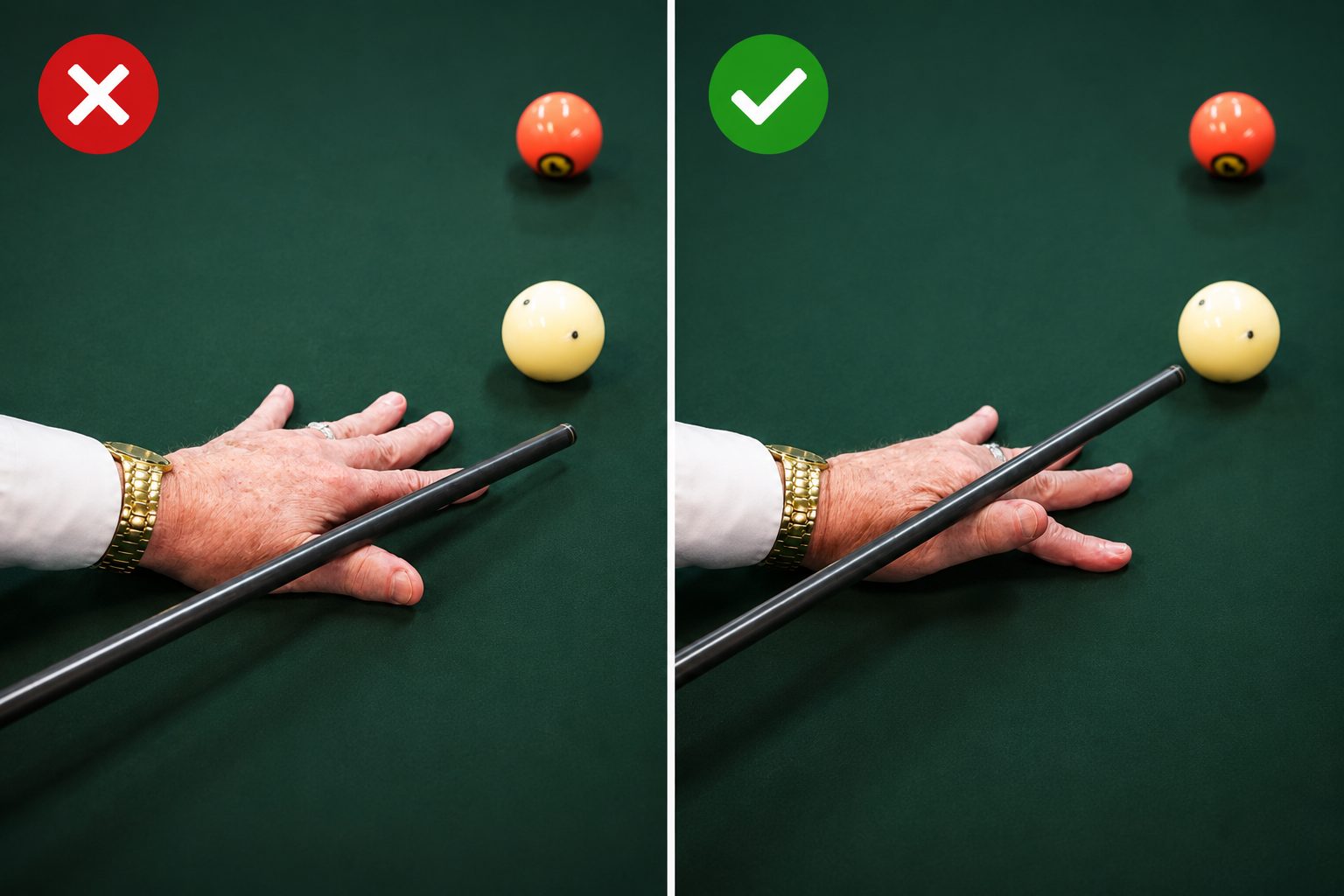
This one sounds a bit mad. I sometimes say to players: “try to break the slate.” You obviously can’t. But that’s how hard you should be gripping the table with your front hand.
Your front hand is the foundation of every single shot. When it’s soft - fingers barely resting on the felt, bridge hand just sitting there - everything above it wobbles. Your cue drifts. Your stroke gets inconsistent. And you blame your aiming when the real problem is six inches below the cue ball.
A firm front hand does something else most players don’t expect. When you grip the table hard, your back hand naturally relaxes. You stop choking the cue. Your stroke becomes smoother. Your follow-through stays straight instead of jerking off to one side.
It sounds too simple to matter. But it’s everything.
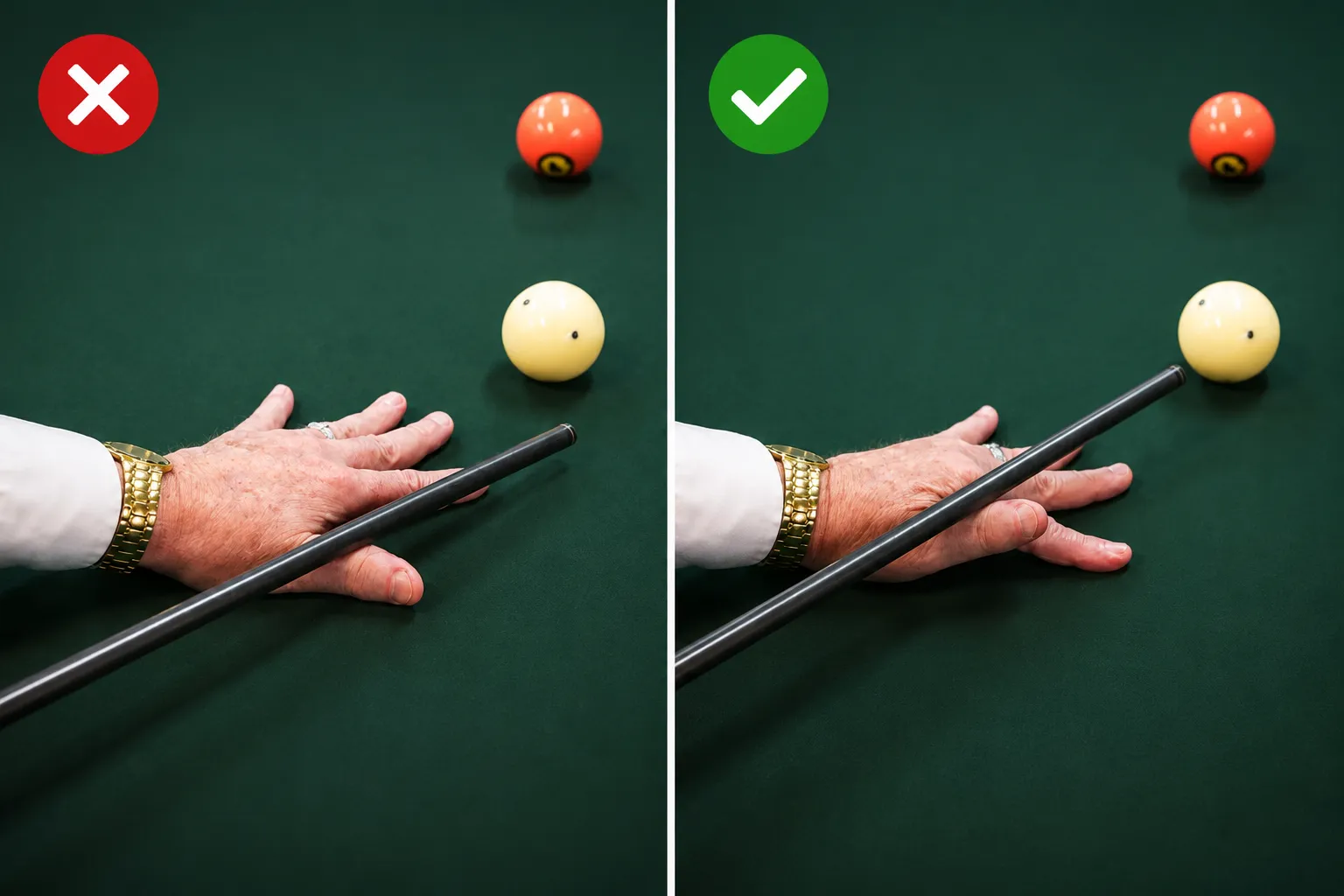
The difference between an incorrect, loose front hand and a correct, tight one.
Fundamental #3: Stay down on the shot
You don’t get paid for standing up. I’ve said that to hundreds of players and I’ll keep saying it.
Most club players, the second the cue ball leaves contact, they’re already straightening up. Standing tall, cue coming off the table, eyes somewhere else. I call it “cleaning ceilings” - the cue flies up in the air after the shot like you’re dusting the light fixtures.
Here’s why it matters. When you stand up during the shot - and you’re usually doing it during, not after - the cue lifts on the way through. If you’re hitting at a 5 on the cue ball, you finish at a 7 or an 8. If you’re hitting low at a 2 for a draw shot, you finish at a 4 or 5. No wonder the ball won’t come back.
Play the shot and count: one-thousand-one, one-thousand-two. Then stand up.
Admire your work. Watch where the cue ball goes. That one or two seconds of staying down is the difference between knowing why you missed and guessing.
Why these three and nothing else?
I’m not saying there aren’t other things that matter. Of course there are. Your feet, your elbow, your eye line - all of it matters eventually.
But in 60 years of coaching, I’ve found that if you get these three right, most of the other problems either fix themselves or become obvious enough to address. A firm front hand steadies everything. Cue on the chest keeps the stroke straight. Staying down lets you actually see what’s happening.
Fix these three, and you’ll start to pot balls you’ve been missing for years, without even changing your aiming. Without buying a new cue. Without any complicated systems.
Just these three things, done properly, every shot.
Where to start
Don’t try to fix all three at once. Pick the one you’re most guilty of - you probably already know which one it is - and focus on that for your next few sessions. Nothing else. Just that one.
Once it starts to feel natural, add the second. Then the third.
The players who improve fastest aren’t the ones who try to fix everything overnight. They’re the ones who own one thing completely, then move on.
Wayne Carey is a 6-time New Zealand Open Champion, Oceania Champion, and has represented New Zealand at 18 World Championships. He’s coached players from age 8 to 96 across 30+ years.
These three fundamentals are the first thing I cover in my free training. If you want to see exactly what I mean - and check whether you’re making the mistakes I see every week - grab it here. Takes about 10 minutes and is completely free.
Free Training
Ready to fix this in your own game?
Get the free diagnostic video + PDF cheat sheet - no card required.
Get My 3 Proven Shot Fixes - Free